Meta Muse Is Here. Is Your Dealership Website Ready to Sell to an AI Agent?

Meta Muse changes the job of a dealership website. The site no longer serves only human shoppers and search-engine crawlers; it must now serve AI agents that can research inventory, compare vehicles, navigate pages, fill out forms and act on a buyer’s behalf. Dealers whose sites cannot be reliably discovered, understood or used by those agents risk becoming invisible at precisely the moment shoppers are delegating more of the buying journey to AI.
Dealer AI Websites was built for that transition. It combines fast, accessible dealership pages with structured inventory, natural-language search, machine-readable vehicle data, AI-readable Markdown, an MCP server and CRM-ready lead delivery—turning the dealer site from a digital brochure into an operating surface for both buyers and their agents.
Editorial note: Meta’s product is called Muse, while Muse Spark is the model family that powers Meta AI and supports agentic work. Muse Image is a separate image-generation product. This article concerns the Muse personal AI agent launched in September 2026.
What Meta Muse Actually Launched
Meta launched Muse in the United States on September 8, 2026, initially through iOS, Android, the web and WhatsApp, with AI-glasses access announced for the following months. It is not merely a chatbot. Meta describes Muse as a personal AI agent that can turn goals into plans, continue working after the user leaves, open its own browser, fill out forms, send emails, make purchases and negotiate on the user’s behalf.
Muse runs inside a dedicated cloud environment called Muse Secure VM. Meta says each user’s environment is isolated, credentials are kept in secure storage, sensitive actions require confirmation and a separate Sentinel agent reviews actions before they reach the internet. Users control which apps Muse can access and can revoke those permissions.
The important capability for dealerships is Muse’s ability to move between native integrations and the open web. When a direct connector or public API is available, Muse can use it; otherwise, it can operate through a browser. That means a dealership does not necessarily need a formal Meta partnership before Muse encounters its website—but the website still has to expose information and actions in a form the agent can successfully interpret.
Meta is also building distribution around the agent. Muse launched with shopping and service connectors, access to Shopify’s catalog and Stripe Link checkout; Meta later announced additional retail, productivity and payment integrations. Muse is also slated to work through Meta’s AI glasses, allowing a user to ask the agent to act on products or information in the user’s field of view.
This matters because Meta controls consumer surfaces at enormous scale: Facebook, Instagram, WhatsApp, Messenger, Meta AI and an expanding family of AI glasses. Muse turns those surfaces from places where shoppers discover and discuss products into potential starting points for tasks that continue across apps and websites.
Why Automotive Is Exposed
Automotive retail is particularly vulnerable to this shift because vehicle shopping is already a research-heavy, comparison-heavy process. Buyers evaluate price, mileage, trim, equipment, history, financing, trade value, availability and dealer reputation before making contact. These are exactly the kinds of multistep information tasks that an AI agent can compress.
A Q2 2026 study by a major industry research firm found that 63% of in-market shoppers said they definitely or probably would use AI during their next vehicle purchase. AI tools were already approaching automotive-specific sites as a research channel—36% versus 38%—yet only 29% of dealers said they had begun adapting for AI-powered search.
The trend is not simply more chatbot use. The same firm’s car buyer journey research found that 19% of all recent buyers and 25% of new-vehicle buyers had used AI sites or AI-generated overviews. Among mostly digital buyers who used AI, 84% reported high satisfaction with the overall shopping experience, compared with 71% among mostly digital buyers who did not use AI.
Muse also launched with automotive use cases in its own narrative. Meta said the agent could help a user sell a car for a higher price, while Reuters described Muse as able to complete transactions such as selling a car on a user’s behalf. If an agent can represent the consumer on the selling side, it is reasonable to expect it to become increasingly involved in discovery, comparison, contact and negotiation on the buying side as well. That final point is an industry implication, not a confirmed Meta product roadmap.
The New Website Visitor
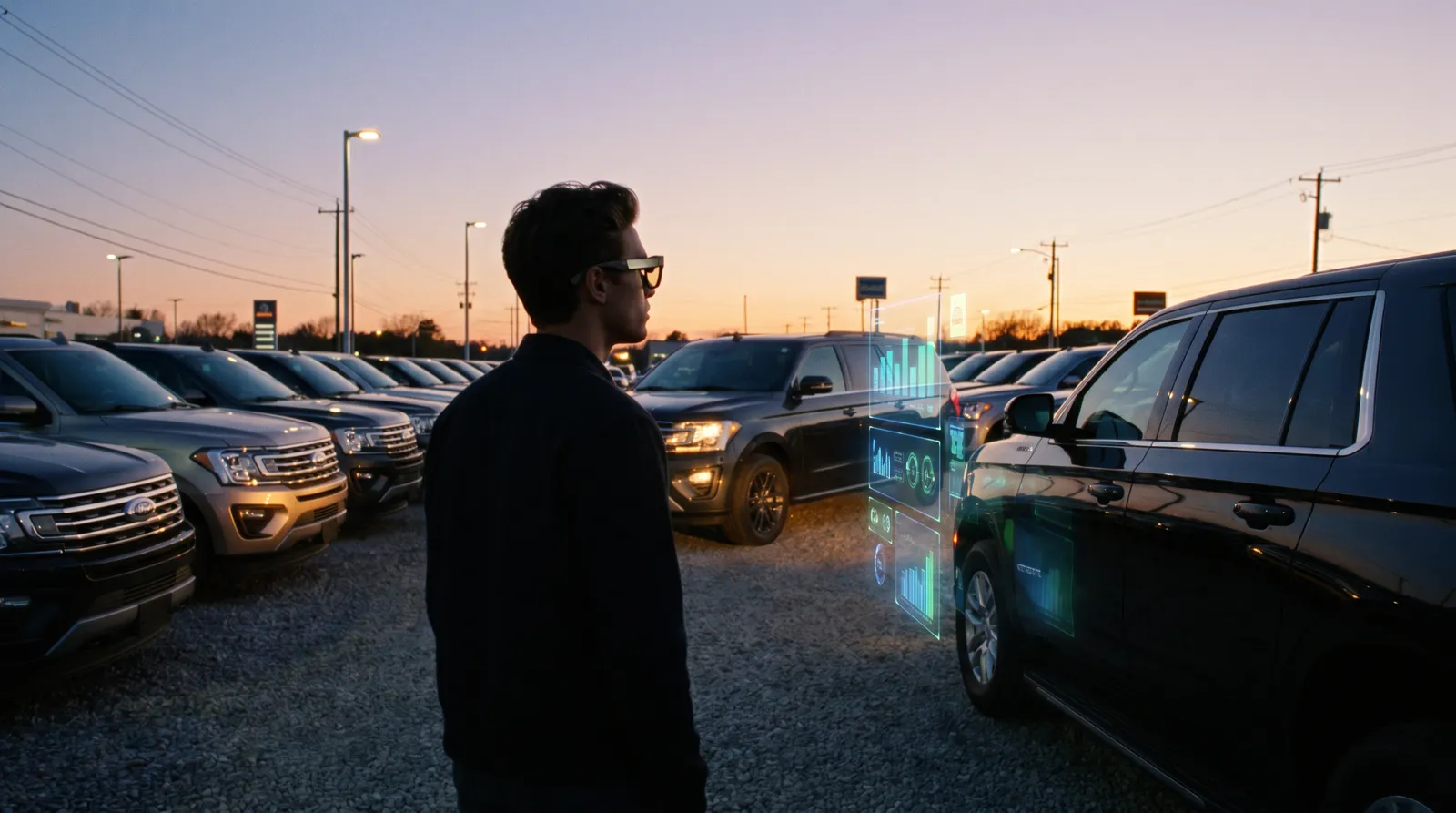
A human shopper can sometimes compensate for a bad website. People infer that a stylized card is clickable, dismiss multiple pop-ups, re-enter data after an error, wait for JavaScript to load and call the store when a form breaks. An AI agent is more likely to follow the site’s underlying structure. If the role of a control, the meaning of a price or the state of a vehicle is unclear, the agent may misread the page, fail the task or choose another source.
Google’s guidance for agent-friendly websites emphasizes semantic HTML, associated form labels, stable layouts, an auditable accessibility tree and explicit tools for supported agent tasks. A real <button> is easier for an agent to recognize than a clickable <div>; a properly labeled field is safer than a placeholder; and a stable call to action is easier to operate than one that shifts or becomes covered by an overlay.
The same foundation helps traditional performance and search. Google defines Core Web Vitals around loading speed, responsiveness and visual stability, recommends an LCP within 2.5 seconds, an INP under 200 milliseconds and a CLS below 0.1, and confirms that its ranking systems use Core Web Vitals as part of broader page-experience evaluation.
When a Dealer Site Fails
An unprepared dealership website does not necessarily display an error saying, “Muse cannot use this site.” The failure is often silent. The agent simply cannot retrieve the vehicle, verify the facts, complete the lead action or trust the result—and the shopper receives a different recommendation.
The inventory may never enter the answer
Inventory trapped behind client-side scripts, session-dependent filters or poorly labeled page elements is harder for agents and crawlers to parse. If price, mileage, availability, VIN, trim and equipment are not present as reliable text or structured data, an agent has to infer facts from a visual interface. Structured markup such as Car, Vehicle, Product and Offer gives machines explicit meaning instead of asking them to guess.
The consequence is a new form of lost impression share. The dealership may physically have the right vehicle, but the agent cannot confidently establish that it does. A marketplace, large retailer or technically prepared competitor becomes the safer source.
Stale data becomes a trust problem
A human may tolerate discovering that a vehicle sold yesterday. An AI agent tasked with producing a shortlist is expected to return dependable results. If inventory status, price or equipment differs between the page, feed and form, the agent can pass incorrect information to the shopper. Agentic-commerce guidance consistently prioritizes synchronized inventory, pricing and product data because an autonomous system must act on facts without manual reconciliation.
For dealers, stale information creates more than inconvenience. It can produce wasted calls, duplicate work for the BDC, poor customer expectations and an early trust deficit before an employee ever enters the conversation.
Forms become failure points
Muse can fill forms, but that does not mean every form is usable. Unlabeled fields, hover-only controls, surprise modals, puzzle CAPTCHAs, shifting buttons and validation messages that are not programmatically tied to inputs can interrupt browser agents. Agent-readiness guidance recommends semantic controls, visible labels, meaningful error states and critical information in the initial HTML or an equivalent machine-readable route.
A failed lead form is not merely a UX issue in this environment. It is a failed transaction between the shopper’s agent and the dealership. The buyer may never know which technical obstacle caused the store to disappear from consideration.
The dealership loses context
Legacy forms often reduce a rich shopping session to a name, phone number and generic “interested” message. An agent may already know the buyer’s use case, must-have equipment, budget, trade, preferred appointment window and alternatives considered. If the site cannot accept and route that context, the BDC begins the conversation from zero.
That repetition weakens the main promise of personal agents: less work for the user. The dealer that can preserve vehicle, question and intent through the handoff offers a smoother experience than one that forces the shopper to explain everything again.
The store becomes dependent on aggregators
Muse’s launch strategy shows the value of direct catalogs and connectors. Meta has announced access to Shopify’s catalog and multiple retailer and payment integrations, allowing the agent to move from request to product and, in some cases, payment without navigating an arbitrary storefront.
Dealers without clean first-party inventory interfaces may leave marketplaces and third parties as the easiest machine-readable route to their own vehicles. That shifts visibility, data and influence away from the dealer’s domain—and can make the dealership interchangeable at the exact moment the agent creates the shortlist.
Slow pages compound every problem
Large script stacks, oversized images and unstable interfaces make tasks slower and less reliable. Google’s historical mobile research found that 53% of visits were likely to be abandoned when pages took longer than three seconds to load, while its current Core Web Vitals guidance continues to emphasize fast loading, responsiveness and visual stability.
Agents may have different patience thresholds than humans, but latency still consumes compute, increases the chance of timeout and creates more opportunities for an interaction to fail. Speed is therefore not a cosmetic score; it is infrastructure for both human conversion and agent completion.
Bad bot policy creates a false choice
Opening everything to every bot is not the answer. Modern edge networks and bot-management tools now distinguish AI training crawlers, AI search bots and user-directed assistants, including separate Meta agents such as Meta-ExternalAgent and Meta-ExternalFetcher, and let site owners monitor and control each category.
Dealers need an intentional policy: allow useful discovery and user-directed actions, protect sensitive routes, rate-limit abuse and monitor agent traffic. A blanket block can erase the store from AI discovery; a blanket allow can create security and scraping exposure.
What “Muse-Ready” Means
No public Meta specification defines a “Muse-ready dealership website,” and Meta has not publicly confirmed support for llms.txt or the Model Context Protocol in Muse. Those formats should not be marketed as guaranteed Muse integrations. The practical readiness standard is broader: can an authorized agent discover the store, understand current inventory, operate the shopping flow and hand off the customer safely?
A credible dealership readiness checklist includes:
- Crawlable, server-rendered facts: Key vehicle information, policies, hours and contact routes should be available without fragile client-side interactions.
- Current structured inventory: Price, mileage, VIN, stock number, trim, equipment and availability should remain synchronized.
- Automotive schema: VDPs should use appropriate
CarorVehicle,Product,Offer, breadcrumb and dealership markup. - Semantic, accessible controls: Buttons, links, forms, labels, error states and navigation should be represented correctly in HTML and the accessibility tree.
- Fast, stable pages: Core Web Vitals and real-device performance should be treated as operational requirements.
- Predictable conversion paths: An agent should be able to request availability, a test drive, a price or a human handoff without navigating pop-up layers.
- Machine-readable alternatives: JSON inventory interfaces, Markdown representations or task-oriented tools reduce dependence on visual browser automation.
- Consent-aware lead actions: Any action that sends personal data should require clear user intent and preserve an audit trail.
- Intent-rich CRM delivery: The dealer should receive the vehicle, source, question and conversation context—not just contact fields.
- Measured agent traffic: AI referrals, tool calls, completion failures and resulting leads should be tracked separately from ordinary sessions.
How Dealer AI Websites Gets You Ready
We built Dealer AI Websites as an agentic website platform for new and used dealerships, not a chatbot bolted onto a legacy site. The human-facing website, AI inventory discovery, machine-readable data and CRM handoff run as one system.
We make inventory understandable
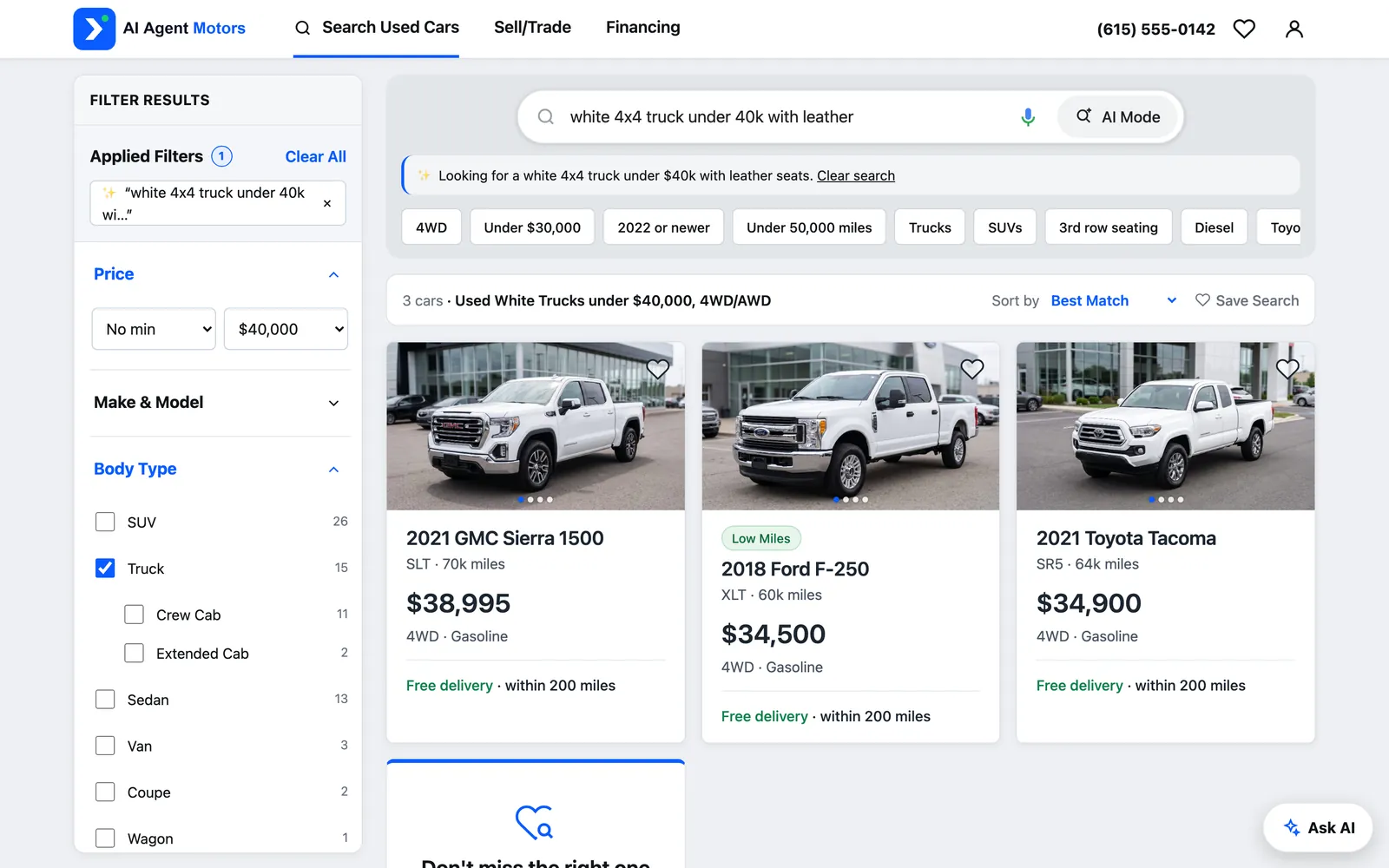
Shoppers search in plain English or by voice, results are ranked by meaning, and an AI assistant on every vehicle page answers from that vehicle's actual data. Messy dealer notes are cleaned into structured fields, and every new arrival gets a fact-checked summary. Inventory syncs from your existing feed provider, such as HomeNet, vAuto or Dealertrack, every 30 minutes, so the site matches the lot.
That serves both sides of the transaction. A human can ask for a "white 4x4 truck under $40,000 with leather," while a machine receives explicit vehicle facts instead of reconstructing them from a visual results page.
We give agents clean reading paths
Every site ships with full schema.org markup, an llms.txt map, Markdown versions of pages, image sitemaps, clean URLs and a JSON inventory interface. It also ships with an MCP server whose tools let an AI application search inventory, read a vehicle, check availability, get a price explanation and request dealer contact.
MCP is an open standard that lets AI applications discover and call tools with defined inputs, so a model can query inventory without guessing how a visual interface works. Our tools follow the Dealer Agent Protocol, an open specification for how shopping agents read dealer inventory, prices and offers, with explicit guardrails: your DMS and CRM stay behind the line, price, required charges and conditional offers stay separate, and availability is never overstated. Meta hasn't publicly confirmed MCP support in Muse, but task-oriented interfaces make a dealership ready for every AI application that does, and far less dependent on brittle browser clicks.
We turn agent intent into a dealer-owned lead
Leads arrive as ADF/XML in the CRM you already use, including VinSolutions, DealerSocket, Elead, CDK and DriveCentric. Lead flows cover availability, final price, test drives, trade value, history reports, video walkarounds and AI-assistant handoffs, with source tagging and automatic retry if delivery fails.
That's the point. The goal isn't just to let an AI quote your page. It's to let a shopper, or the shopper's agent, move from discovery to a traceable first-party action that reaches your store with useful context.
We make the human experience better too
Our live client site scores 100 for mobile performance and 100 for accessibility on Google PageSpeed. Pages are cached at the edge, images are served in modern formats, and there's almost no third-party JavaScript. Shoppers get saved vehicles, price-drop alerts, sold-vehicle alternatives, new-arrival alerts and short forms, and you get built-in A/B testing.
Don't take our word for it. Run your own site and ours through PageSpeed Insights, test them with a screen reader and submit a test lead. The same foundations that help browser agents (speed, accessibility, structured content and predictable actions) also remove friction for human shoppers.
We offer a low-risk way to start
The Pre-Owned plan is $499 per month, Franchise is $999 per month, and each additional rooftop is $499, with no setup fee, the first month free and no contract. A pre-owned site can launch on a subdomain alongside your current website, while a full franchise deployment replaces the new-and-used site.
That subdomain path gives franchise dealers a practical test: launch an agent-ready used-inventory experience, route leads to your existing CRM, compare speed and lead quality, and decide on a bigger move based on results instead of a slide deck.
A 30-Day Dealer Action Plan
The Muse launch should trigger an operational audit, not a panic purchase. Dealers can evaluate readiness in four phases.
Week 1: Test discoverability
- Ask Muse, ChatGPT, Claude, Gemini and Perplexity the same local inventory questions a shopper would ask.
- Record whether the dealership, a marketplace or a competitor appears.
- Inspect
robots.txt, sitemaps, canonical URLs and bot-management rules. - Validate VDP schema and confirm that price, availability, mileage, VIN and equipment match the visible page.
Week 2: Test usability
- Give a browser agent specific tasks: find a vehicle under a budget, compare two units, check availability and request a test drive.
- Run the same tasks by keyboard and screen reader to expose accessibility-tree failures.
- Check forms for labels, autocomplete, error handling, CAPTCHA barriers, modal interference and mobile layout shifts.
- Measure top SRPs and VDPs with PageSpeed Insights and field data in Search Console.
Week 3: Test the handoff
- Submit every lead type and verify arrival in the CRM.
- Confirm the source, vehicle, shopper question and consent state survive the handoff.
- Test sold-unit logic, missing-photo vehicles, price changes and feed latency.
- Document who owns agent-originated leads and how quickly the BDC responds.
Week 4: Choose the architecture
- Require the website provider to demonstrate structured inventory, accessible controls, AI-readable output and an agent-completed lead—not merely an AI-branded chat widget.
- Request written details on data ownership, inventory update frequency, bot policy, APIs, security, CRM routing and cancellation terms.
- Compare retrofitting the current platform with launching Dealer AI Websites on a used-inventory subdomain.
- Establish baseline metrics for AI referrals, VDP engagement, completed lead actions, CRM delivery and appointment rate.
The Competitive Consequence
Muse is not important because every shopper will immediately delegate an entire car purchase to Meta. It is important because it normalizes a new interface: tell an agent the goal and let the agent operate the software. Once shoppers adopt that behavior for travel, shopping, bills and scheduling, they will bring the same expectation to automotive retail.
The dealer website therefore has a new minimum job. It must be easy for a machine to discover, understand and act upon—without becoming less useful, less secure or less persuasive to a person. Dealers that meet that standard can preserve first-party visibility and convert agent-assisted demand into CRM conversations. Dealers that do not may still own the inventory, but another platform will own the shopper’s path to it.
Dealer AI Websites is built for that future: structured, frequently synced inventory, natural-language shopping, agent-readable pages, protocol-based tools with guardrails, fast and accessible design and ADF lead delivery in a dealer-owned environment. Book a demo or browse the live demo store.
Resources and Source Material
Meta and Muse
- Meta: Introducing Muse, the personal AI agent
- Meta: Muse announcements from Connect 2026
- Meta: Introducing Muse Spark
- Meta: Muse Image
- Meta: Muse Privacy Policy
- Reuters: Muse launch, capabilities and concerns
- Reuters: Muse as a potential Meta revenue engine
- Reuters: Muse security-warning update
- Reuters: Muse human-concierge test
- Associated Press: Meta launches Muse
- TechCrunch: Muse features, connectors and plans
Agent-ready web standards
- Google Search: Core Web Vitals
- Google Search: Page experience
- web.dev: Build agent-friendly websites
- Schema.org: AutoDealer
- Model Context Protocol: Tool specification
- Model Context Protocol: Introduction
- Stripe: Preparing for agentic commerce
Dealer AI Websites
- Dealer AI Websites: platform, features and demo
- Dealer AI Websites: terms and pricing
- Live demonstration dealership
- Dealer AI Guy: The next dealer website will be an agent
- Dealer AI Guy: Operator’s guide to dealership AI agents
Get your store agent-ready
Every Dealer AI Website ships with structured, synced inventory, an MCP server built on the Dealer Agent Protocol, a grounded AI assistant and pages that load instantly. Pre-Owned from $499/mo, Franchise $999/mo, first month free.
Book a demoBrowse the live demo store